Thursday, May 7, 2020

A bird of wild places

I had passed my driving test in the States in the summer of 1985, but it was nearly another three years before I did so in the UK, at the second attempt. (Amusingly, perhaps, I failed the first time for being too cautious pulling out at a junction – not something I could have been accused of often since, especially on twitches.) So there I was in Birmingham in early May 1988, new licence burning a hole in my pocket – I hired an Escort van for a few days, slung a mattress in the back, and headed off on a road trip.

If I’d been a bit more clued-up, given the time of year I might have headed to the coast – North Norfolk, perhaps, or Spurn – but I decided on a swing round the Peak District. It was great fun – I was young, I had the freedom to visit new places, go where I wanted, park up and sleep where I felt like… And the scenery was fantastic, picturesque villages full of old stone houses, and bleak and wild landscapes.

The best day was Saturday 7 May. I started off by walking along the old railway line at Miller’s Dale, then spent most of the rest of the day in the Goyt Valley. A walk in the woods alongside Fernilee Reservoir was much the same experience as I now get (in normal years) in the wooded combes of Exmoor or the Quantocks – a parachuting Tree Pipit, a dapper male Pied Flycatcher singing its little ditty, a Wood Warbler shivering with the effort of pouring out its melancholic heart (oh, that song!), and a couple of scorching male Redstarts. Absolutely magical for a young birder, and still so even now.

But these were all birds I had seen before, albeit only a few times each by then. There was one bird that I hoped to see for the very first time, and for that I needed to head further up the valley, above the woods and out on to open moorland. Past Errwood Reservoir I stopped again and walked down to the old packhorse bridge (a delight in itself) – there I heard an unfamiliar thrush-like song. Was it? Was it? Yes! In one of the small trees just upstream of the bridge was a fantastically smart male Ring Ouzel singing away. Wow! I found another further up the valley, and a few Red Grouse even further up too, where the bracken turns to heather.

(As an aside, it was also the last day of the football season, and late afternoon I was sat in the van in a car park, a Mistle Thrush showing fabulously in a small tree just in front of me, as I listened to the radio and celebrated my beloved Aston Villa clinching promotion back to the old First Division. But I digress.)

Ring Ouzels have been special birds for me ever since that day, birds that speak to me of wild places. On Exmoor, Blackbirds moved ever further up the open combes in the 1990s, and we lost Ring Ouzel as a breeding species in 2002, so most of my encounters in recent years have been with migrants. Still, some of those have been in their old haunts, the wild and open landscapes where they fit so perfectly. But even if they are just in a horse paddock on Portland, every single one is an experience that is eagerly anticipated, and to be savoured to the full when it happens. 

Wednesday, May 6, 2020

Which way to go?

As is so often the case, in normal years, I spent a lot of time in spring 2000 on Portland, and so it was again on the morning of Saturday 6 May. There hadn’t been a fall, but there were a few migrants around to make an enjoyable morning’s birding – Pied Fly, Cuckoo, Whinchat, and best of all a Wryneck. Then, late morning, two rare birds broke within a few minutes of each other – an Alpine Accentor at St Margaret’s in Kent, and a Hudsonian Whimbrel at Goldcliff in Gwent.

A classic twitcher’s dilemma. I needed Alpine Acc; on the other hand, Hudsonian Whimbrel, though only a subspecies at the time, was already mooted as a potential split, and was much the rarer bird of the two. There was no way of getting to both that day, and no way of guessing which, if either, would stick to the following day. So, which one do I go for?

The Alpine Acc won, at least to begin with – if I saw it, I could tick it straight away, and as I hadn’t been able to get to the Rimac bird in 1994 it was an itch that needed to be scratched. So I headed off up to Dorchester, then east. I hedged my bets, though, as there were no updates forthcoming, and went up the A354 via Blandford Forum to Salisbury, rather than heading for the faster A31/M3 route.

By Salisbury there was a ‘no further sign’ message on the accentor, but the whimbrel was still present. So I changed tack and headed northwest towards Warminster, in the general direction of Gwent. Then, just north of the A303, there was another message saying the accentor had been seen again briefly. Meanwhile the whimbrel had been lost for the time being, so I changed tack again, did a very quick U-ey back to the A303, and started off east again. Pretty soon after that there was another update on the accentor saying ‘no further sign’ – there was even some doubt whether the most recent report was gen. Plus the whimbrel was now back again.

This was getting silly now. With only the pager messages to go on, if I kept reacting and changing plans I could spend the rest of the afternoon zig-zagging across southern England and getting nowhere in the end. So I formulated a new plan: if I kept heading east A303/M3 I reckoned I could reach the M25 by 4 pm, and at that point I would be about equidistant (at least in terms of driving time, if not actually in miles) between St Margaret’s and Goldcliff, with time still to get to either. Whichever bird was showing at that point, I would commit to going for, hard.

And so it was. At 4 pm, as the M25 junction hove into view, there had been no further sign of the accentor for a couple of hours, but the Hudsonian Whimbrel was showing well. Decision made – M4 here I come!

It was well into the evening before I made it to Goldcliff, and a bit of a walk to get round to by the seawall and join the small crowd, but I was quickly directed on to the whimbrel once there. We didn’t seem generally to know much about them back then, apart from the dark rump and tail, duly seen as it flew a short distance to a new feeding area. But the slight differences in coloration and the stronger, brighter head pattern, that we now know are features, were fairly obvious that evening. The head pattern in particular made it easy to pick out from the flock of 60+ Eurasian Whimbrel it was with.
 
As dusk approached, I left to head home, with the pager telling me that the accentor had still not been seen again. So the insurance had been well and truly bought, compared to a dispiriting dip – it had taken me a while, but I had made the right decision in the end.

(I was even happier when the same or another Alpine Accentor was found at Corton in Suffolk the following Saturday – it was only a one-day bird, but news broke early enough for lots of birders to get there and get good views, this time including me.)

Tuesday, May 5, 2020

Little Swift

Monday 5 May 1997 was a Bank Holiday. My own car was in dock, so I had hired a car for the weekend – trouble was, it was a deal off a local firm that was a cheap daily rate, but not unlimited mileage. Also, I had discovered over the previous couple of days that the steering was a bit cranky. So, I was tempted by a Wood Sandpiper at Pennington Marshes in Hampshire that would have been a year tick, but I decided not to drive that far and headed for the Exe estuary instead.

By a little after midday I had been there a while, but not seen much of note. Then, bang – Little Swift on the Isle of Wight! Big, big need – a lot bigger listers than me back then still needed it too. Here I go then! Swifts are notoriously difficult to twitch, as they can disappear at any moment, but can also reappear, sometimes hours later. Some will hang around all day, but very few stay longer. So the only tactic to employ really is to commit early and hard, get to the site and see what the score is, accepting that the chance of connecting is likely to be a lot less than 50:50.

Trouble was, like I said earlier, it was a Bank Holiday Monday. Traffic was a nightmare – sheer volume plus an accident or two gumming up the works. The swift was at Bembridge, at the east end of the island, and most birders were heading for the ferry from Portsmouth. For me, however, the best bet looked to be the Lymington-Yarmouth ferry and a drive the length of the Isle of Wight. If I could get there. It took three and a half hours to get to the ferry terminal, to find I’d just missed a ferry and had to wait nearly an hour for the next one. All the while messages were saying that the bird was showing very well whizzing up and down the clifftop. If I’d chosen to go for the Wood Sand I would have been in prime position, and on site by now, and I knew it – instead I was kicking my heels and doing my pieces. All I could do was book the car on the next ferry and wait.

While I was waiting, Matt Prince and Nicky Bacchiu turned up from Devon too, and as the ferry price was per car, I invited them to join me. I had stressed out to the max, and as we at last drove off the ferry at Yarmouth, bird still showing, I lost it. I’ve pulled some strokes while driving on twitches, but that afternoon (early evening really) I did things I had not done before, and have not since. Matt once told me they realised what they were in for when I decided to beat the line of traffic off the ferry by going round a mini roundabout the wrong way, and as for when I overtook a car on a blind uphill bend – well, the pitch of Matt’s voice from the back betrayed genuine fear. It was years before either of them got in a car with me again after that day.

Happily, we got lucky and arrived in Bembridge in one piece. The bird had left the clifftop, however, and its current whereabouts were unknown. We joined the search to relocate it. Time passed, rendering the crazy driving earlier pretty pointless as it happened. It must have been nearly an hour later when suddenly there was a shout and a run on. On one of the surburban streets inland from the cliff a small band of birders swelled to a crowd, all staring upwards. There, right overhead, was the Little Swift! Fabulous views as it circled at rooftop height above us – we could even see the paleness of the undertail as it spread it. The birders around me were a sea of beaming smiles.

The swift and the flock of hirundines it was loosely associated with moved a little, and the crowd followed it, down some wooden steps to a new vantage point. The bird remained viewable from there until dusk. As the light started to fade we gave up, having had our fill, and were sat in the car when the last birders turned up, including LGRE, who hared past us and down the steps just in time to see the swift before it headed off to roost.

We headed back towards the ferry in the dark, at a rather more sedate pace, much to Matt and Nicky’s relief. Later I found out that a friend had rolled his car somewhere in Hampshire on the way down – he was OK, though he spent a night in hospital under observation, the car was a write-off, and of course he missed the bird. A salutary lesson after my earlier antics – suffice to say I’ve paid more attention to the phrase ‘Drive to Arrive’ ever since.

Monday, May 4, 2020

Down in the Park

In the mid-80s, while I was a student at Birmingham University, my local patch was Edgbaston Park – not hugely exciting, but rewarding for a poor young birdwatcher with no transport. As well as the usual woodland birds, back then it had regular Ruddy Ducks among the wildfowl on the lake, and occasional surprises such as Brambling and Crossbill. By 1986 I had graduated from the university, but was living and working nearby, still visiting the patch, and still seeing student friends regularly. One night in the Mason Hall bar, I got talking to one guy, a friend of a friend I’d not met before, and he showed a bit of interest in going birdwatching, so I invited him to join me that weekend.

So we met up on Sunday morning, 4 May, and nipped into the park through the usual gap in the fence opposite the halls of residence. A pleasant walk down through the woods on the west side later, we arrived at the small bridge over the spillway at the southwest corner of the lake. There, in a small tree right by the bridge, was a pair of Lesser Spotted Woodpeckers! A lifer for me, on patch, and a bird I had really wanted to see. I knew they had been recorded in the park occasionally before, but not for years. And now, in front of me, not just one but a pair! Even better, they appeared to be investigating a hole in the tree, perhaps as a potential nest site. I watched, rapt, as they showed extremely well for several minutes, then suddenly flew off into the wood. I was over the moon!

We moved on and saw a nice selection of the other birds the park had to offer too, then, the morning’s visit over, my companion and I went our separate ways. I never saw him again – I can’t even remember his name –so I assume he decided that birding wasn’t for him. I guess he didn’t realise just how lucky he was – the one time he goes birding and he sees that! Given the amount of time we as birders spend looking for Lesser Spots every year, it hardly seems fair, does it?

Sadly, I never saw the Lesser Spots again either – presumably they similarly thought that tree wasn’t for them – it was very close to the path, after all. But for me that brief encounter is one of those memories, little cameo moments in my life as a birder, that will live forever.

Sunday, May 3, 2020

Ton up!

One of the many things that isn’t now going to happen this month was my planned big daylist round Somerset. I’ve not done a big May one, so it would be a fun challenge – maybe next year. I’ve been doing a New Year’s Day bash, however, for years. Recording 100+ species on 1 Jan is relatively easy in some counties with the right amount of planning and effort, but I’ve found it tricky in Somerset, and have only ever managed it once…

The route varies every year, but my usual start point is Ashcott Corner on the Avalon Marshes to get off to a strong start. However, the appearance of a Cattle Egret at Wet Moor in late December 2007 (they were rare then) threw a spanner in the works, and required some last-minute rejigging of the route. So, with the weather set fair, on 1 January 2008 I arrived at its favourite fields near Long Load a little before 7.30 am, just as it was starting to get light. Nearly an hour later the Cattle Egret had not shown, I was already behind the clock, and had only 28 common species under the belt. Crucially, however, some of that total were birds that are easily missable on a daylist, but which had given themselves up: the Little Owl was in the same tree it had been in a few days before, but Green Woodpecker, Yellowhammer, and Bullfinch were all distinct bonuses.

Pausing only to note House Sparrow and Collared Dove in Long Load itself, I headed up to Ashcott Corner and the Natural England car park, arriving at 8.50 am. I could only allow myself just over an hour at Shapwick Heath, just enough to get out to Noah’s Hide and back, but I still got most of my target species, including a good selection of wildfowl and some ‘one-hitters’ I was unlikely to see elsewhere such as Greylag Goose, Lesser Redpoll, and Reed Bunting. Unusually, a Water Rail showed itself, but I had to settle for only hearing Cetti’s Warbler, Siskin, and Kingfisher. Even with limited time, I was a bit surprised not to get Marsh Harrier (though there were fewer around then than now), but as I was leaving another birder pointed out a big bonus – a ringtail Hen Harrier! It was now after 10 am, though, and I was still ‘only’ on 55 species (compared to 60 when I set my then record of 94 species in 2003). Momentum is an important factor in daylisting, and a slow start can mean you either miss species entirely or spend too much time trying to see them at secondary sites later in the day.

I normally do Westhay Moor next, but passed on it this time and headed straight to Wookey Hole, where a Dipper showed well, as did Marsh Tit. Next stop was my usual spot for Marsh Tit back then – the now-defunct feeders by the car park at Ebbor Gorge, just a few minutes’ drive away. Nuthatch, Treecreeper, and a calling Jay (all again easily missable daylist birds) were added quickly there – great! I had clawed back some time and was now only 10 minutes behind schedule.

Another bonus was a Mistle Thrush flying across the road near Cheddar – my luck appeared to be in with uncommon resident species, and my optimism had returned. Paul Bowyer had already texted me to say that the goodies of recent days were all still at Cheddar Reservoir – Great Northern Diver, Black-necked Grebe, Scaup, and Ruddy Duck all fell easily, plus the more usual wildfowl and gulls (including Goldeneye, easy then, rather trickier now). An excellent result, leaving me on 71 species as the last minutes of the morning ticked away.

On the spur of the moment I decided to squeeze in a visit to Brean Down (another regular spot, but one I had initially decided to leave out this time). It quickly felt like a mistake, as there were lots of people around, and while Raven and Stonechat fell, the other main targets – Rock Pipit and Black Redstart – didn’t. Moving on swiftly to Burnham-on-Sea, quick looks at the scrub and beach behind Andy Slade’s house and off the bottom end of the seafront came up trumps with more ‘one-hitters’ – Blackcap, Sanderling, and Ringed Plover – as well as several commoner coastal species. I was up to 85 species with still four hours of daylight to go!

At Combwich Pill the staked-out wintering Common Sandpiper played ball and was quickly added to the total, then a Grey Wagtail (a regular New Year’s Day bogey bird) landed on the road in front of me as I drove through Otterhampton. Surely I had by now used up my quota of luck for the day, but apparently not, as virtually the first bird I saw when scanning at Wall Common was a Short-eared Owl drifting along the beach! I picked up more waders too, coming in on the rising tide, and a good stomp round the saltmarsh was productive too – Meadow Pipit and Skylark were duly seen, and the hoped-for Jack Snipe flushed from under my feet, but a Rock Pipit was an unexpected retrieve after the earlier miss. This was getting ridiculous – now on 96 species, I’d broken my previous record and it was still only just gone 2 pm! On the way back out, a Stock Dove in roadside fields on the Bridgwater side of Cannington was another score from a good but not 100% reliable stakeout spot, continuing an unreal hit rate on these on the day.

Meanwhile, the Cattle Egret had been seen at Long Load, and, flushed with success, I decided to give it another go. It was a long drive and a risk in the context of the day, but yet again I got lucky and the bird showed almost immediately walking across a gap in a hedge. A good thing too, as time was now running short, and even visits to the remaining stakeout sites would have to be lightning quick, never mind having time to walk in good habitat in the hope of cadging a few more species. Catcott Lows obliged with Pintail but not Golden Plover or Black-tailed Godwit (perhaps my most glaring misses on the day). The honour of being the 100th species fell to a Sparrowhawk shooting across roadside fields near Clewer – a late score for another hit-or-miss daylist bird. Back at Cheddar Reservoir, the Goosanders were now in for the night, and scouring the gull roost produced another real bonus bird – an adult Yellow-legged Gull.

As 4 pm came and went, I dashed back down to the Avalon Marshes to finish off at Ham Wall, in the hope of Bittern or Barn Owl. No joy with either of those, but as the light finally faded, a calling Tawny Owl became the 103rd species recorded on a memorable day.


Saturday, May 2, 2020

Going Dutch

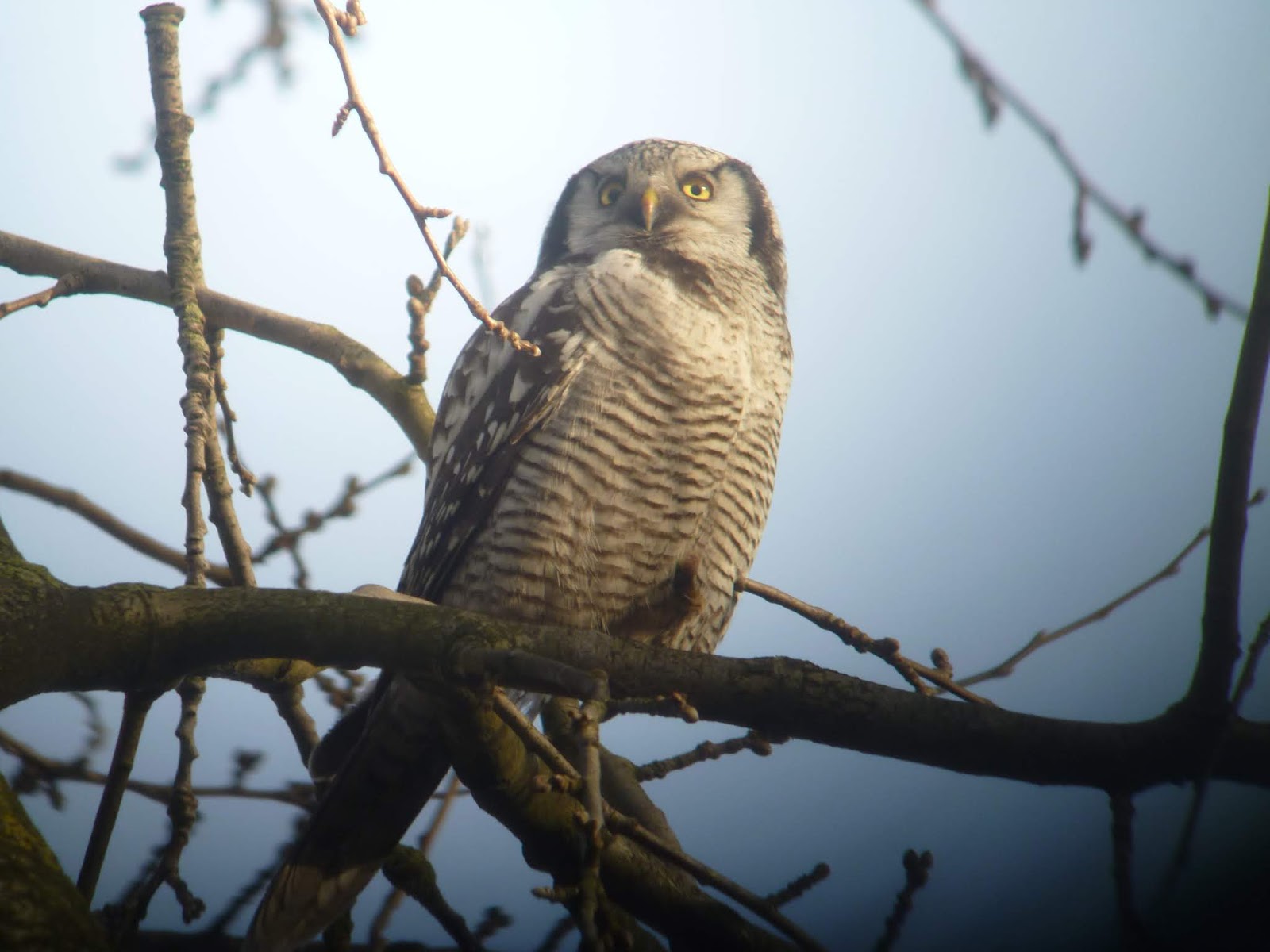
In late autumn 2013 there was a bit of an influx of Hawk Owls further south into Europe than usual (though sadly none made the sea crossing to Britain). In particular, one took up temporary residence in the city of Zwolle in the Netherlands. It seemed an ideal opportunity to see a much-wanted bird on a relatively cheap day trip. So, early on Monday 2 December I flew from Gatwick to Schiphol, picked up the hire car, and drove the hour and a half or so east to Zwolle.

The site, though easy to find, seemed pretty unlikely for a forest owl, and was hardly picturesque – a line of trees along a service road sandwiched between an industrial estate and the Marsweg, one of the main routes south out of the city. But I knew l was in the right place, as there was a healthy enough crowd of Dutch birders (for a Monday morning, and a bird which had been present for a few days) looking up into the trees, big lenses trained on one spot.


And there it was! A stunning, magnificent Northern Hawk Owl, sitting there looking down at me! Wow! I would be lying if I said that the setting didn’t detract just a little bit from the moment (seeing a pair in the more traditional setting of a Finnish forest was at that point in the unforeseen future), but it was fabulous views of a dream bird. And the location also provided a comedy moment – a security guard from one of the industrial units came out to have a chat with the crowd and the owl, swooping from tree to tree, nearly took his head off.

It appears I had got lucky – the previous day it had been over the road in the nearby park, and much trickier to pin down. But today the owl was moving up and down the same line of trees, and showing well nearly all the time, so I spent another hour or so watching it and chatting to some of the Dutch birders.

At last, however, I had had my fill, and besides, I had another target in mind. There was a Two-barred Greenish Warbler at a small nature reserve (Kamperhoek) by the Ijsselmeer, only about 40 minutes away. Having missed a couple of British ones, it would also be a world tick.

I knew where the site was, sure, but little about access or where to look for the bird once there, so it was a bit of a wing and a prayer job. But, as back home, if you want to find the bird, find the birders. I saw a few cars parked in a layby alongside the reserve, and noticed a birder walking back towards them, so stopped and piled out. In the end it was a fairly short though muddy walk to where the small crowd was gathered, and I settled down to wait with them.

After an hour and more of no joy, my mind was turning to when I had to leave for my flight back, when suddenly there was a shout. My Dutch is non-existent, but the excitement was unmistakable – the Two-barred Warbler was showing! It was being a typical phyllosc, flitting rapidly among the trees on the other side of a small dyke, so getting on it was tricky. But the Dutch birders were again very friendly and helpful (and most spoke good English), so I managed to follow their directions and get a few good if brief looks at it. It sat still for a minute or two and a couple of guys got scopes on it, so we all had scope views, albeit partially obscured. Not great views, but good enough.Then, suddenly, it vanished, and that was it for the afternoon.

(There's a brief YouTube clip of it, from another day, which gives a fair idea of what it was like: 

By now time was running on, so I headed back towards Amsterdam, checking fields on the polders for geese etc. without much success. Still, I reflected as I jumped on my return flight, it had been a cracking day.

Friday, May 1, 2020

Desert Wheatear, Salthouse

It was mid-November 1996 and I was still going strong in my big year, well into the 340s, but likely year ticks were starting to run out, so there was no rest for the wicked when a Desert Wheatear was found at Salthouse in Norfolk. Bill Urwin and his son Dave were also going for a big yearlist – as we only live a few miles apart, we travelled together a lot that year, which helped me immensely – so we arranged that they would pick me up in the early hours to be at Salthouse for dawn on the 17th. Then I did something a bit daft – as I knew I wouldn’t be driving, I went to my local pub, which was a bit notorious at the time for lock-ins. And so it came to pass that I just had time to stagger back up the road and change into birding gear before Bill and Dave appeared. I jumped into the back seat, steaming drunk, and promptly fell asleep and snored all the way to Norfolk. Charming, eh?

At dawn I got my comeuppance – it was cold and wet at Salthouse, I was hungry and tired, and a stinking hangover was just about to start kicking in. There were a few other birders there, and people started fanning out to look for the bird. I tried too, but pretty quickly ran out of steam – I felt terrible, it was clear the others weren’t having any joy finding it, and then it started to rain again. I stood, sunk in my (entirely self-inflicted) misery, and looked down at the ground. There, not three feet away from me, trying to take shelter in an open and very inadequate bush, was the Desert Wheatear!

It looked just as miserable as I felt, and plainly didn’t want to move from where it was, so I backed off it and called people over. Everyone present got great views – shame the bird was soaking wet, but so were we. I honestly have little other recollection of that day, and what notes I have don’t help, but the moment when I realised I was standing right next to the bird is etched on my memory.